Thinking about buying an investment property in Kirkland? You are not alone. Kirkland sits in one of the Eastside’s higher-cost housing markets, which means the numbers can look intimidating at first, but it also means there is real demand, strong location appeal, and more than one path to value if you buy carefully. In this guide, you will get a clear look at Kirkland’s market, the basics of multi-unit and middle-housing options, and the key issues to review before you make an offer. Let’s dive in.
Why Kirkland stands out
Kirkland is a premium Eastside market with a 2025 population of 97,410 and a median household income of $150,414. Census QuickFacts also reports a median gross rent of $2,401, an owner-occupied housing rate of 60.8%, and an average household size of 2.35. For investors, that points to a market where renters may value efficient layouts, strong access to jobs, and well-located housing.
The City of Kirkland describes the city as a rapidly growing community with a vibrant downtown, other urban centers, and improving transit and bike access. The city also notes that more than 75% of its land area is zoned for housing. That matters because it shows Kirkland is planning for continued housing growth rather than treating it as an afterthought.
Compared with nearby Eastside cities, Kirkland appears to compete in the same high-cost band as places like Redmond rather than a lower-priced suburban tier. In practical terms, you should expect pricing pressure on acquisitions, but also a deep pool of tenants and buyers who want to be close to employment, amenities, and transportation options.
What counts as multi-unit in Kirkland
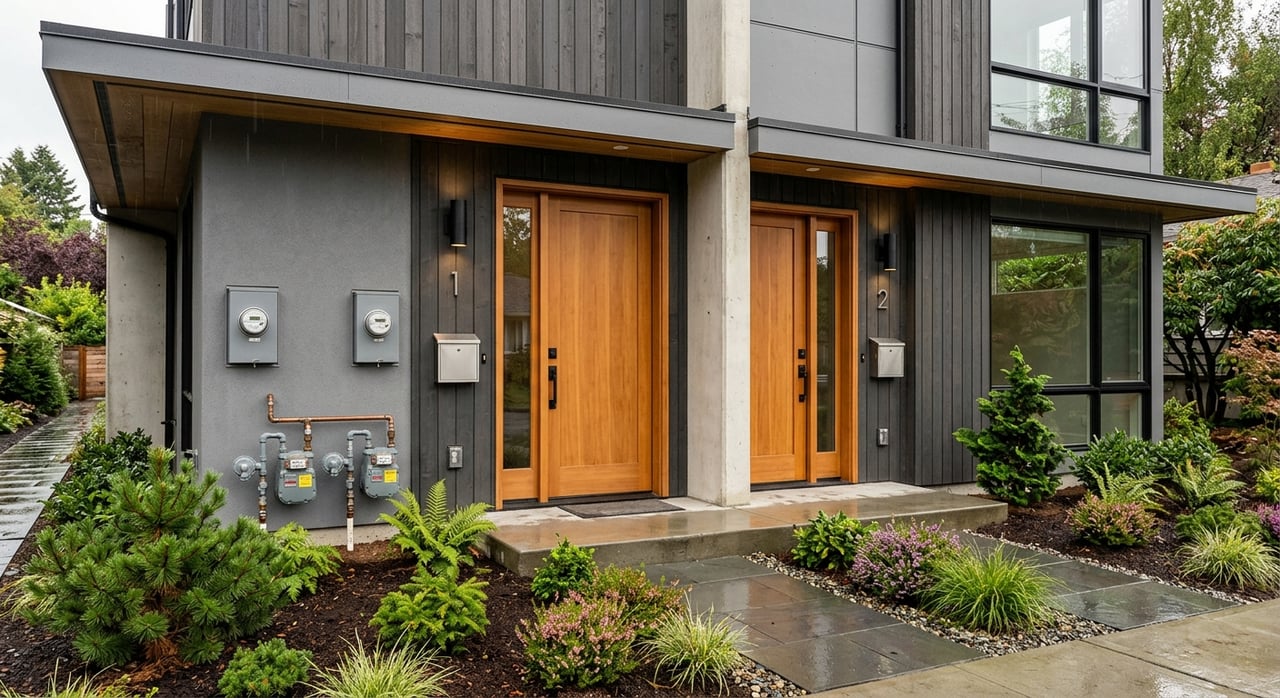
If you picture Kirkland as only single-family homes, that picture is outdated. The city explicitly allows duplexes, triplexes, cottages, and residential suites. Its 2025 middle-housing amendments also expanded options to include townhomes, stacked flats, four-unit homes, and in medium- and high-density zones, five- and six-unit homes.
For many buyers, this is the biggest shift to understand. A property that once looked like a simple house purchase may also need to be evaluated for future unit potential, redevelopment options, or a hybrid owner-occupant and rental strategy.
Middle housing basics
Kirkland’s middle-housing rules allow:
- Four units per lot in all residential zones
- Six units per lot within a half-mile of a Major Transit Stop
- Up to two attached ADUs on middle-housing projects
Right now, Kirkland identifies the STRIDE I-405 bus rapid transit station as its current Major Transit Stop. The city also notes future major transit stops along the RapidRide K Line.
This means location matters even more than usual. Two properties with similar square footage can offer very different long-term potential depending on zoning and transit proximity.
Unit lot subdivision explained
Kirkland adopted unit lot subdivision rules in 2025. The city says these rules can make infill easier, allow each unit lot to be separately owned, and support smaller-lot projects such as townhomes, duplexes, and ADUs.
For an investor, that can create flexibility. In the right setting, separate ownership structure may improve exit options, project design, or long-term value. It also means a property search should go beyond bedrooms and bathrooms and include site configuration and legal use potential.
Where rental demand is strongest
Not every part of Kirkland serves the same type of renter. The city has two designated urban centers: Totem Lake and Greater Downtown Kirkland. Kirkland defines these as mixed-use areas with existing or planned high-capacity transit that are suited to future population and employment growth.
That is important because rental demand often follows a simple pattern. People want housing near work, services, transportation, and recreation.
Greater Downtown Kirkland
Greater Downtown Kirkland includes the historic downtown, the NE 85th Street Station Area, the Kirkland Transit Center, a portion of the Cross Kirkland Corridor, and two Google campuses. These are meaningful demand drivers for renters who want access to jobs, mobility, and daily amenities.
If you are comparing small multifamily or value-add properties, this area may deserve a closer look because the location story is easy to understand. That does not guarantee a good investment, but it can support more consistent renter interest.
Totem Lake
Totem Lake includes The Village at Totem Lake, Totem Lake Transit Center, Evergreen Hospital, and Totem Lake Park. Those anchors give the area a strong mix of services, employment, and everyday convenience.
For many investors, areas with this kind of built-in activity can be attractive because they support a wider range of tenant needs. They may also offer a clearer long-term case for demand than a property that depends on only one major employer or one narrow use case.
Transit corridors and future growth
Kirkland’s long-range planning is steering growth toward transit corridors, commercial centers, and 10-minute neighborhoods. The city also highlights Lake Washington as a major recreational and natural amenity, which adds to Kirkland’s broader appeal.
The planned RapidRide K Line is expected to connect Kirkland to Totem Lake, Downtown Bellevue, and Eastgate, with service set to begin in 2030. Since that service is future, not current, it should be treated as a possible long-term demand driver rather than a reason to stretch your numbers today.
Value-add ideas to consider
In a market like Kirkland, many of the best opportunities come from improving use, not just waiting for rent growth. That is where careful analysis can make a big difference.
Adding or legalizing an ADU
A likely value-add path is adding or legalizing an ADU. Kirkland also offers a pre-approved detached ADU program that is intended to make detached ADUs faster and cheaper to pursue.
That does not mean every property is a fit. You still need to review site conditions, permitting path, and design constraints. Still, for the right lot, an ADU can create added income potential or support a flexible living arrangement.
Targeting middle-housing potential
Some buyers will focus on existing cash flow. Others may prefer a property with future unit-count upside. In Kirkland, targeting a lot that can support middle housing may be one of the more interesting ways to create value over time.
This is especially relevant if you are deciding between two properties with similar pricing. If one site offers clearer pathways for additional units or better transit-based density potential, it may deserve stronger consideration.
Looking at unit lot subdivision
Where parcel layout and zoning align, unit lot subdivision may create another path to value. The city’s guidance suggests this can support projects like townhomes, duplexes, and ADUs while making infill easier.
This is not a shortcut strategy. It requires detailed review early in the process. But for investors who want options, it is a feature worth identifying before you buy, not after.
Underwriting watch-outs in Kirkland
A good-looking property can still be a weak investment if the underwriting misses key local realities. In Kirkland, the biggest mistakes often happen when buyers focus too much on top-line rent and not enough on feasibility and operating limits.
Review more than price and rent
At a high level, you should underwrite:
- Zoning feasibility
- Parking
- Capital expenditures
- HOA or condo restrictions
- Lease-up timing
These items can change your real return more than a small rent difference. A property with lower initial income but cleaner future options may be stronger than one with a slightly better cap rate on paper.
Understand Washington rent rules
Washington’s residential rent cap generally bars increases during the first 12 months of a tenancy. After that, increases are generally limited to 7% plus CPI or 10%, whichever is less. The Washington State Department of Commerce says the 2026 maximum annual rent increase percentage is 9.683%.
Washington law also generally requires 90 days’ prior written notice for a rent increase. Some newer properties and other situations may be exempt, which is why legal review matters before you assume a future rent path in your pro forma.
For buyers, the practical takeaway is simple. Do not build your entire investment case around broad, uncapped rent growth. In this market, the better deals are often driven by location, unit-count potential, and disciplined operations.
A smart way to evaluate a Kirkland deal
If you are buying your first Kirkland investment property, keep your review process focused and practical. The goal is not to predict everything. The goal is to identify whether the property has solid fundamentals and realistic upside.
Here are a few smart questions to ask early:
- What does current zoning allow on this lot?
- Is the property near a Major Transit Stop or future transit corridor?
- Can an ADU, DADU, or additional unit strategy realistically work here?
- Are there HOA, condo, or site constraints that limit flexibility?
- Does the income plan still work if rent growth is moderate?
These questions can help you avoid overpaying for theoretical upside that may never become practical. They can also help you spot properties where the value story is grounded in real city rules and real demand drivers.
Why guidance matters in this market
Kirkland offers real opportunity, but it rewards careful buyers. You are not just buying a building. You are buying into a set of zoning rules, transit patterns, redevelopment possibilities, and operating constraints that all affect long-term value.
That is why investor-minded guidance matters here. A calm, analytical approach can help you compare properties more clearly, ask better questions before you offer, and avoid costly assumptions about what a site can or cannot do.
If you are exploring Kirkland investment properties, multi-unit opportunities, or a value-add purchase on the Eastside, Angie Holmstrom can help you evaluate the numbers, the property, and the bigger strategy with a practical local lens.
FAQs
What types of multi-unit housing are allowed in Kirkland?
- Kirkland says it allows duplexes, triplexes, cottages, residential suites, townhomes, stacked flats, four-unit homes, and in some medium- and high-density zones, five- and six-unit homes.
Can you add more units to an existing Kirkland property?
- Often yes, but it depends on zoning, lot size, transit proximity, and design constraints.
Where is rental demand strongest in Kirkland?
- Demand is often strongest around Totem Lake, Greater Downtown Kirkland, and key transit corridors because those areas are tied to jobs, services, and transportation.
What is a Major Transit Stop in Kirkland real estate planning?
- Kirkland says its current Major Transit Stop is the STRIDE I-405 bus rapid transit station, and future major transit stops are planned along the RapidRide K Line.
What is the biggest underwriting issue for Kirkland rentals?
- One of the biggest issues is understanding Washington rent-growth limits and notice requirements so your income projections stay realistic.
Is Kirkland still mostly single-family housing?
- Kirkland has expanded middle-housing allowances, and the city says more than 75% of its land area is zoned for housing, so buyers should not assume the market is limited to traditional single-family use.